FCAJ Community Day
Summary Report: “FCAJ Community Day”
Event Objectives
- Introduce practical AI solutions for cloud operations, incident response, customer conversations, and enterprise workforce planning
- Show how AWS services and agentic systems can move operational teams from detecting problems to taking guided or autonomous action
- Share architectures and live demonstrations involving Amazon Nova Sonic, AWS DevOps Agent, Amazon Bedrock AgentCore, Amazon Quick, and Model Context Protocol (MCP)
- Discuss the security and connectivity requirements needed to bring enterprise data and private tools into AI-assisted workflows
Agenda Timeline
| Time | Session | Speakers |
|---|---|---|
| 8:30 – 9:00 | Check-in and settle into the venue | Organizing team |
| 9:00 – 9:25 | Deep Response Engine: From Detection to Autonomous Resolution | Nhat Tran |
| 9:25 – 9:55 | Voice Agents: Building Human-Like AI Conversations at Scale | Trung Vu, Kiet Tran, Nghị Danh Hoàng Hiếu |
| 9:55 – 10:20 | AWS DevOps Agent: Your Always-Available Operations Teammate | Bao Phan Kim, Minh Nguyen Nguyen |
| 10:20 – 10:45 | AI-Powered Productivity: Workforce Planning for Enterprise | Trường Trần, Minh Anh Đặng Cao |
| 10:45 – 11:30 | Building Secure Private MCP Connection with Amazon Quick | Đức Toàn Nguyễn, Nghị Danh Hoàng Hiếu |
Key Highlights
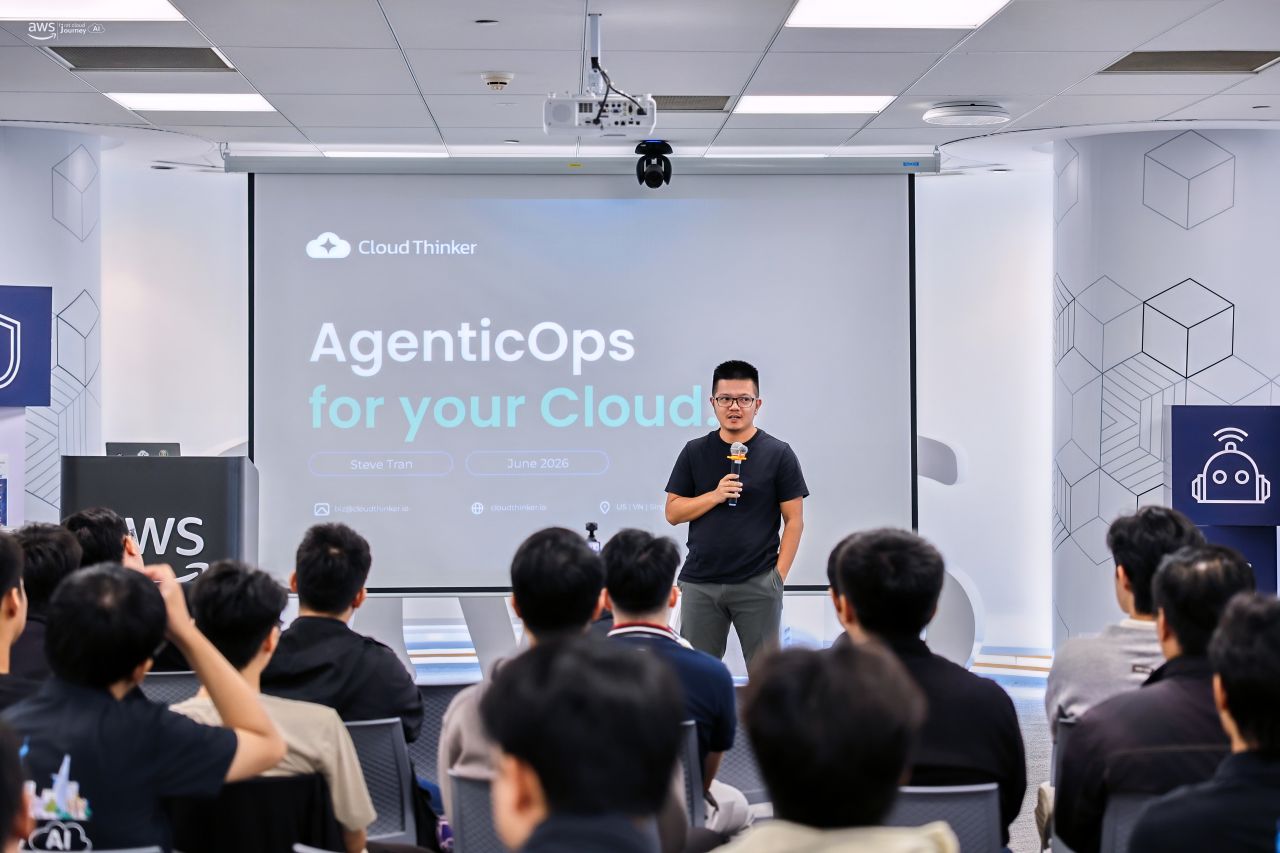
Deep Response Engine: From Detection to Autonomous Resolution
Speaker: Nhat Tran
- Explained the complexity wall that cloud operations teams face as infrastructure and service dependencies grow
- Compared alert-driven operations, where engineers manually investigate every signal, with action-driven systems that can collect context and recommend or execute remediation
- Presented the architecture of a Deep Response Engine and demonstrated an autonomous incident-response flow
- Connected technical improvements to measurable business outcomes such as lower operating cost and reduced downtime
Voice Agents: Building Human-Like AI Conversations at Scale
Speakers: Trung Vu, Kiet Tran, and Nghị Danh Hoàng Hiếu
- Traced the evolution from traditional IVR systems and text chatbots to conversational AI voice agents
- Discussed the main engineering challenges: end-to-end latency, speech accuracy, natural turn-taking, and knowing when a user has finished speaking
- Introduced Amazon Nova Sonic as a speech-to-speech foundation model for real-time conversation
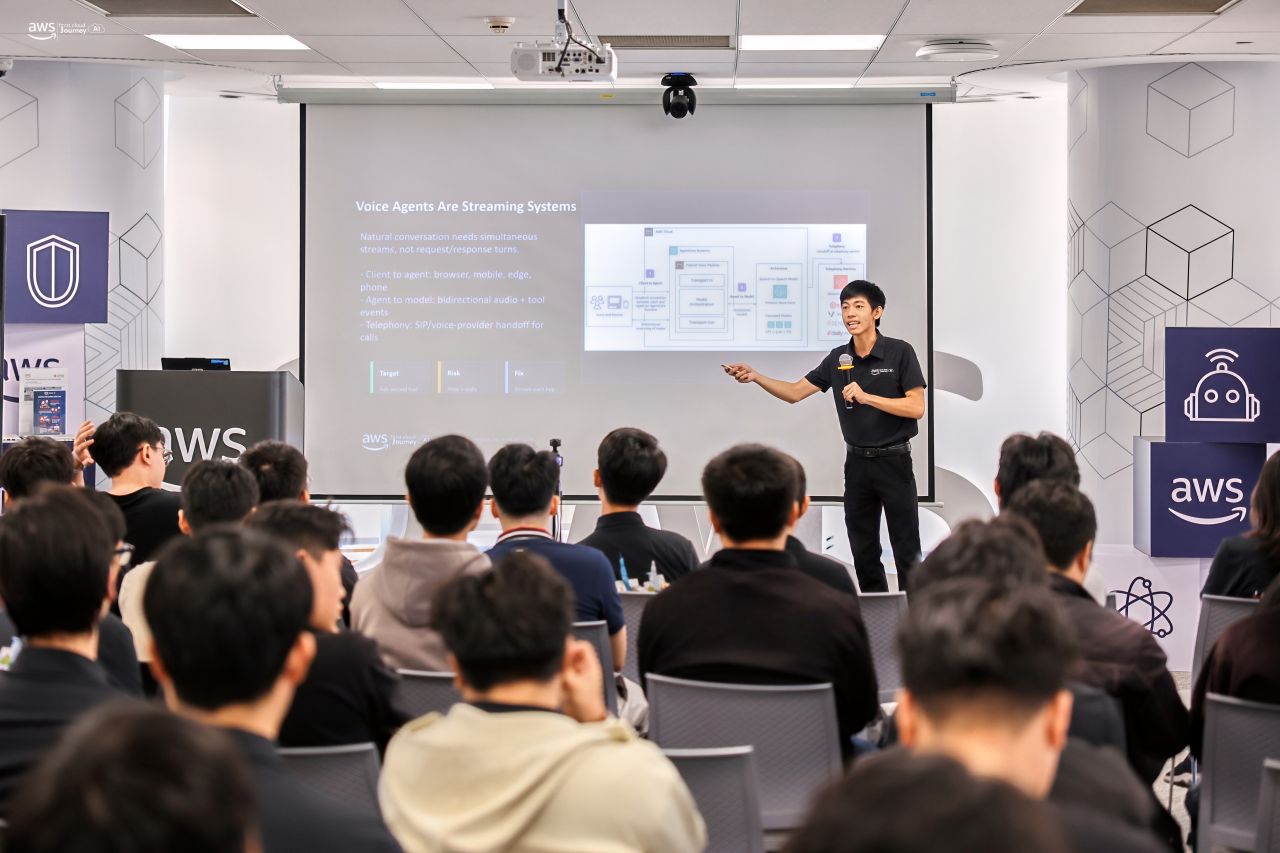
- Explained an architecture combining telephony, bidirectional streaming, Amazon Bedrock, and MCP-connected tools
- Demonstrated enterprise use cases and implementation practices for building voice experiences at scale
AWS DevOps Agent: An Always-Available Operations Teammate
Speakers: Bao Phan Kim and Minh Nguyen Nguyen
- Introduced AWS DevOps Agent and its role in supporting investigation and response throughout the incident lifecycle
- Showed how AI-assisted operations can reduce Mean Time to Detect (MTTD) and Mean Time to Resolve (MTTR)
- Covered support for AWS, multi-cloud, and hybrid environments rather than limiting operations context to a single platform
- Explained the use of Amazon Bedrock AgentCore and multi-agent reasoning to bring together telemetry, operational knowledge, and recommended actions
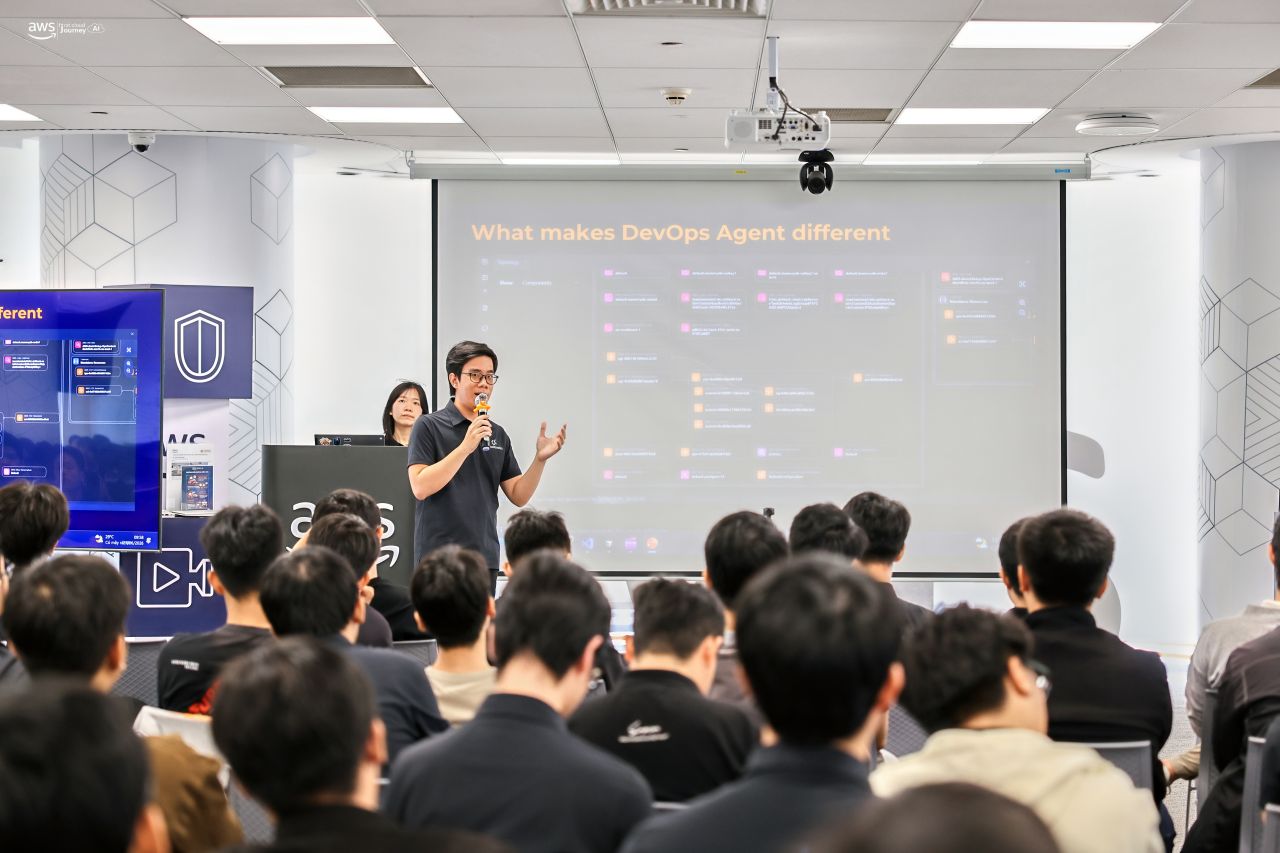
- Walked through a practical Amazon ECS troubleshooting demonstration
AI-Powered Workforce Planning with Amazon Quick
Speakers: Trường Trần and Minh Anh Đặng Cao
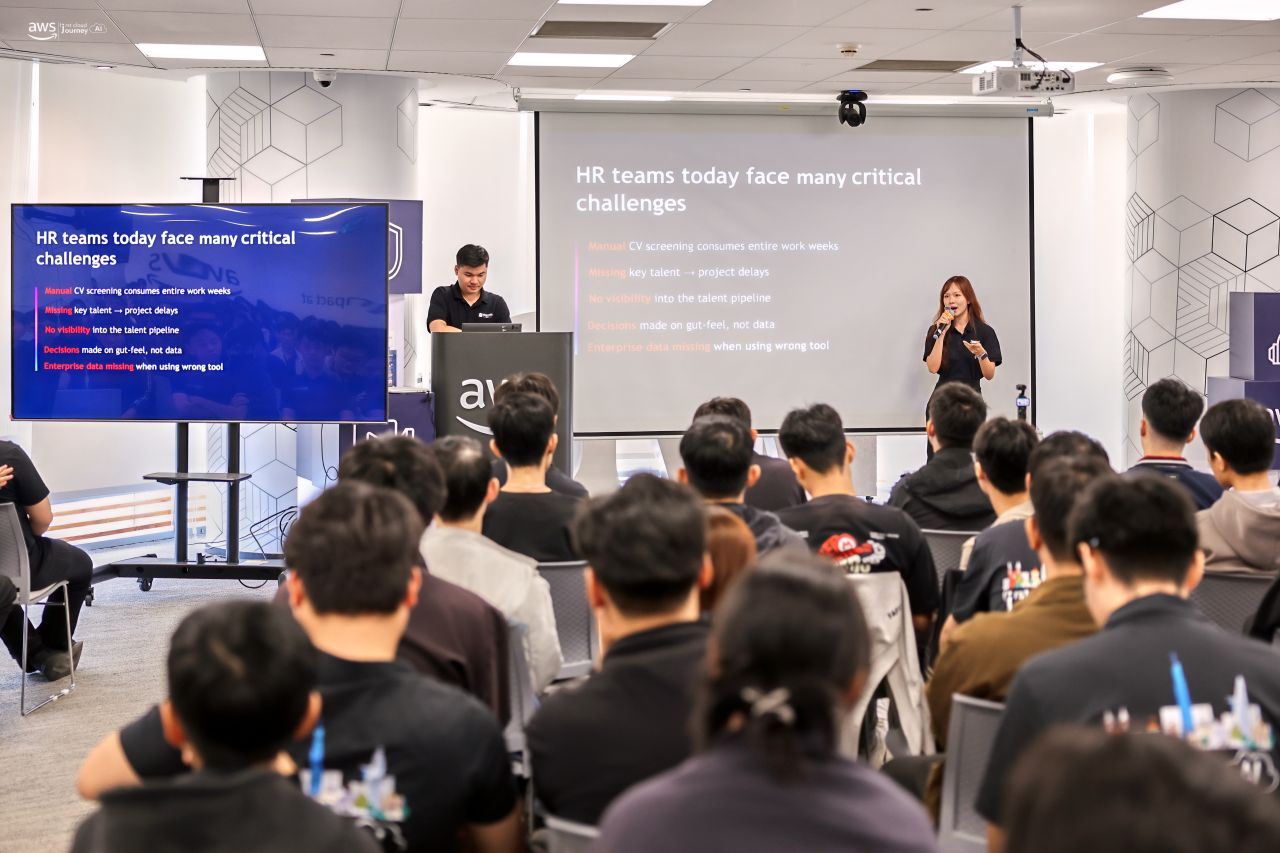
- Framed common HR challenges such as manual CV screening, limited visibility into talent pipelines, and decisions made without complete data
- Introduced the capabilities of the Amazon Quick Suite, including chat agents, research, QuickSight, flows, and automation
- Demonstrated how automation can accelerate recurring HR processes and make workforce analytics easier to access
- Connected operational HR data with strategic workforce planning and enterprise decision-making
Secure Private MCP Connectivity with Amazon Quick
Speakers: Đức Toàn Nguyễn and Nghị Danh Hoàng Hiếu
- Explained how MCP extends an AI assistant by connecting it to external tools and enterprise context
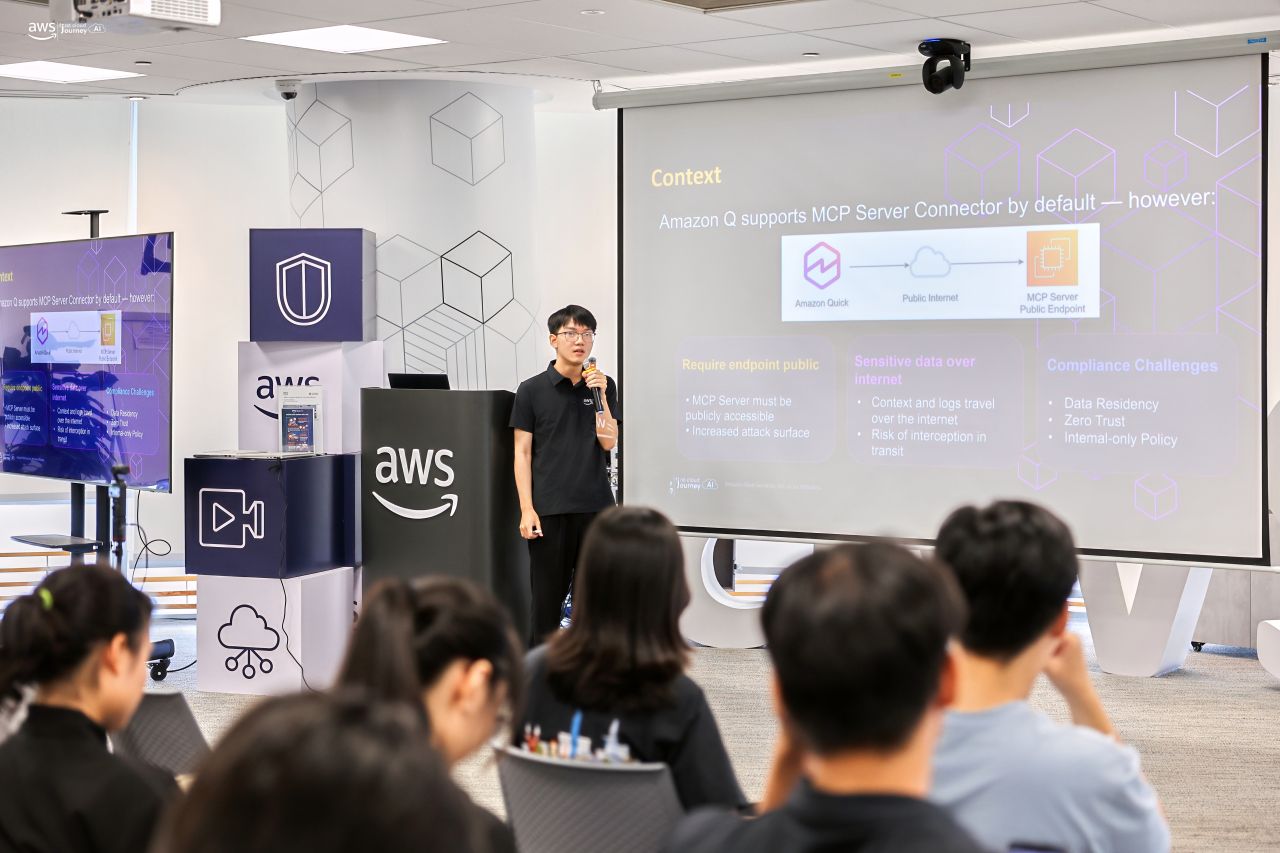
- Identified the risk of exposing an MCP server through a public endpoint, including a larger attack surface, sensitive data traveling over the public internet, and data-residency or zero-trust concerns
- Presented private VPC connectivity as a safer integration pattern for Amazon Quick and internal MCP services
- Combined architecture explanation with a demonstration and practical implementation insights
Key Takeaways
- Modern operations should progress from collecting more alerts to creating a reliable path from detection, through investigation, to action
- Autonomous remediation is valuable only when it has clear context, scoped permissions, observability, and safe fallback paths
- Real-time voice AI is a streaming-system problem as much as a model problem; latency and turn-taking directly shape the user experience
- AI operations agents can reduce MTTD and MTTR by correlating telemetry and operational knowledge, but engineers remain responsible for validating high-impact actions
- Enterprise AI adoption requires private connectivity, least-privilege access, auditable tool calls, and explicit controls around sensitive data
- Amazon Quick can support both knowledge work and workforce planning when it is connected to trusted organizational data
Applying the Lessons to My Work
- Design incident workflows with explicit stages for detection, context collection, diagnosis, recommendation, approval, execution, and post-incident review
- Apply human approval to high-risk remediation while allowing low-risk, repeatable actions to be automated
- Measure operational improvements through MTTD, MTTR, recurrence rate, and the proportion of incidents resolved without escalation
- When prototyping a voice agent, test interruption handling, turn detection, response latency, and failure recovery instead of evaluating only answer quality
- Keep MCP services private where possible and enforce IAM, network boundaries, logging, and least-privilege tool access
- Use trusted data sources and clear access controls when applying Amazon Quick to internal reporting or workforce analysis
Event Experience
Attending FCAJ Community Day gave me a connected view of how agentic AI is moving from experimentation into real operational and enterprise workflows. Instead of presenting AI as a standalone chatbot, the sessions showed it working with telemetry, cloud services, voice streams, internal data, and private tools.
From cloud signals to operational action
- The Deep Response Engine and AWS DevOps Agent sessions made the incident lifecycle concrete: detect a signal, gather context, reason across possible causes, and propose or perform a safe response.
- The ECS demonstration helped connect the architecture to a scenario that cloud engineers can encounter in real systems.
Understanding voice AI as a complete system
- The voice-agent session showed that natural conversation depends on much more than speech recognition.
- The discussion about latency, interruption, and turn-taking clarified why streaming architecture and user-experience design are essential to voice applications.
Connecting AI to enterprise data safely
- The Amazon Quick sessions expanded the discussion from engineering operations to workforce planning and enterprise productivity.
- The private MCP connectivity session was especially relevant because it addressed the security boundary between an AI assistant and sensitive internal systems.
What I left with
- A clearer mental model for agentic operations and autonomous incident response
- Practical criteria for evaluating real-time voice-agent architectures
- A stronger understanding of how MCP connectivity, VPC design, and access control support secure enterprise AI
- New ideas that can be applied to cloud architecture and the DocuFlow AI project, particularly around safe external-tool integration and human approval for high-impact actions
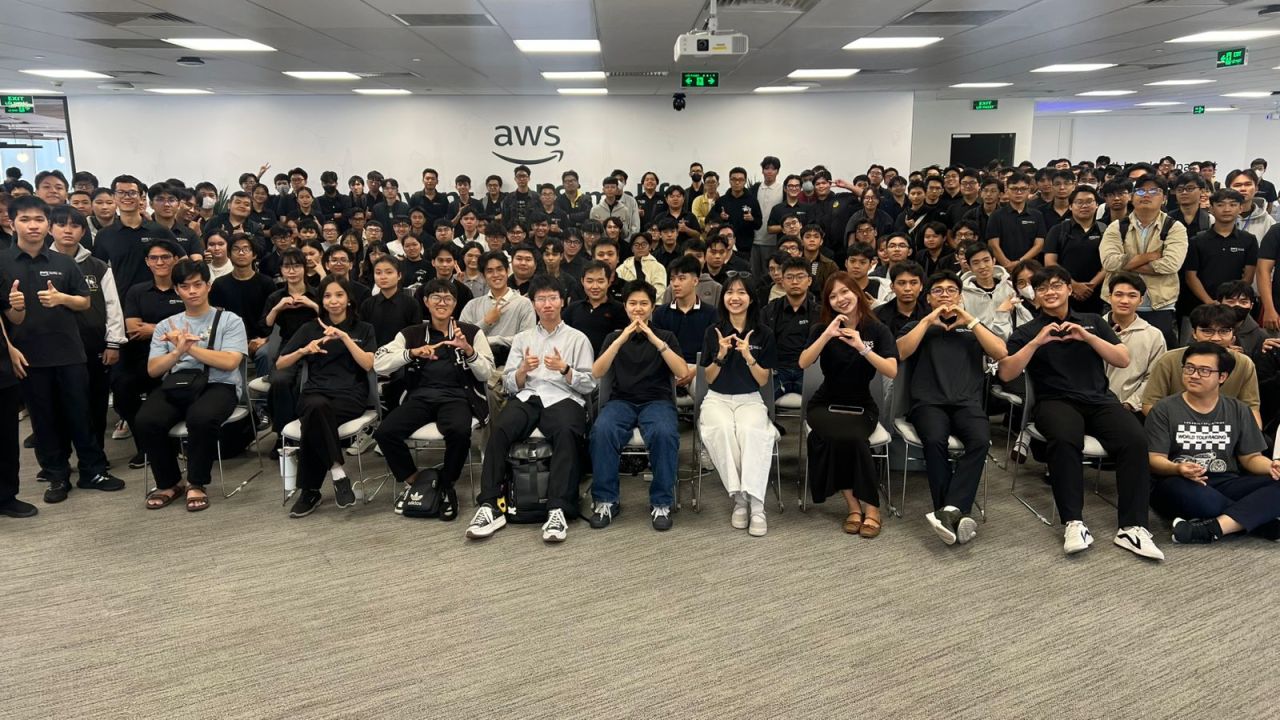
Some event photos
Overall, FCAJ Community Day showed that useful enterprise AI is not only about model capability. It also depends on reliable architecture, operational context, security boundaries, and thoughtful control over when an AI system may recommend or take action.